二十六、Python和JS语法相关
1、Python函数形参默认值的生命周期
形参默认值的生命周期
def func(arg,li=[]):
    li.append(arg)
    return li

v1=func(1)
print(v1)   # [1,]
v2=func(2,[])
print(v2)   # [2,]
v3=func(3)
print(v3)   # [1,3,]

# 项目运行,加载代码时,li=[] 的列表已经创建
# func(1) 时,使用了已创建的li=[]的列表
# func(2,[])时,使用参数传入的[]列表
# func(3)时,再次使用最开始创建的li列表
2、Python列表与指针
n1 = [11,22,33,44,55]
n2=n1
n3=n1[:]

n1[0]=666
n3[1]=999

print(n1) # [666,22,33,44,55]
print(n2) #[666,22,33,44,55]
print(n3) #[11,999,33,44,55]
3、JS变量的作用域
代码在编译时,作用域已经产生了
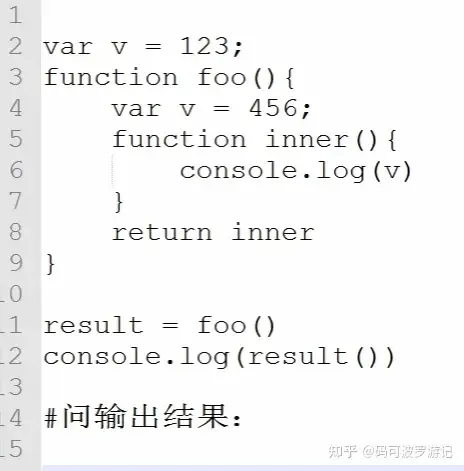
输出:456
4、JS的this变量
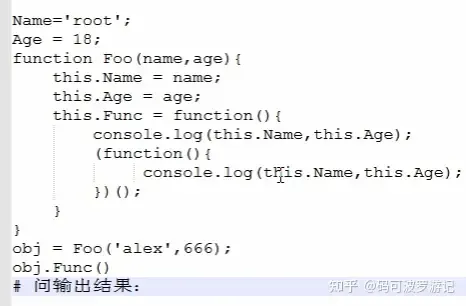
输出: alex 666 root 18
# 每个函数中都有this
function func(){
  # 当做函数执行时,this = window
  console.log(this);
}
func()

function Func(){
  console.log(this);
}
Obj = new Func()
# 这时this = obj
5、JS的面向对象
JS用函数充当类
function func(){ }
func()

function Func(){ //通常首字母大小
   this.name = name;
   thie.age = age;
}
obj = new Func(‘root’,18) // 通过new的方式实例对象
6、JS中无字典,只有对象
Name = ‘james’
obj = {
    Name:‘root’,
    Age: 18,
    Func: Fuction(){
        # this就是obj
        console.log(this.Name)  # root
        var  that = this;
        function inner() {
             # 这里的this 由于下面inner以函数执行,所以this = window。
            console.log(this.Name)  # 输出james
            console.log(that.Name)  # 输出root
         }
        Inner()
       (function () {
            console.log(that.Name)
        })( )  # 括号中定义一个函数,再跟一个括号:创建并执行函数
     }
}
相当于new了对象obj
obj.Func()