扫描线算法
- 扫描线
- 应用
- 应用1:Leetcode.253
- 题目
- 解题思路
- 代码实现
- 类似的题目
- 应用2:Lintcode.821
- 题目
- 解题思路
- 代码实现
- 应用3:Leetcode.218
- 题目
- 解题思路
- 代码实现
- 应用4:Leetcode.850
- 题目
- 解题思路
- 方法一:离散化 + 扫描线
- 方法二:线段树
- 代码实现
- 应用1:Leetcode.253
扫描线
扫描线:假设有一条竖直的直线,从平面的最左端扫描到最右端,在扫描的过程中,直线上的一些线段会被给定的矩形覆盖。如果我们将这些覆盖的线段长度进行积分,就可以得到矩形的面积之和。
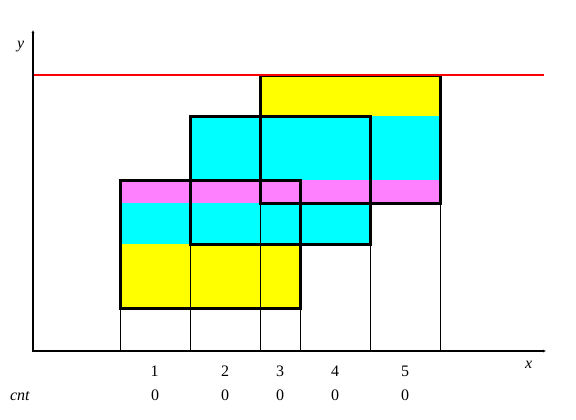
如图所示,我们可以把整个矩形分成如图各个颜色不同的小矩形,那么这个小矩形的高就是我们扫过的距离,那么剩下了一个变量,那就是矩形的长一直在变化。
我们的线段树就是为了维护矩形的长,我们给每一个矩形的上下边进行标记:
-
下面的边标记为 \(1\);
-
上面的边标记为 \(-1\)。
每遇到一个矩形时,我们知道了标记为 \(1\) 的边,我们就加进来这一条矩形的长,等到扫描到 \(-1\) 时,证明这一条边需要删除,那么我们就删除这条边,利用 \(1\) 和 \(-1\) 可以轻松得到这种状态。
还要注意这里的线段树指的并不是线段的一个端点,而指的是一个区间,所以我们要计算的是 \(r+1\) 和 \(r-1\)。
注意,需要 离散化。
应用
应用1:Leetcode.253
题目
253. 会议室 II
给你一个会议时间安排的数组 intervals ,每个会议时间都会包括开始和结束的时间 intervals[i] = [starti, endi] ,返回 所需会议室的最小数量 。
示例 1:
输入:intervals = [[0,30],[5,10],[15,20]]
输出:2
解题思路
标准扫描线算法,把每个会议的起始时间标记为 \(+1\),结束时间标记为 \(-1\),然后将每个时间节点排序,排序时,如果时间相同 \(flag = 1\) 的节点排在 \(flag = -1\) 的节点前面。
然后,依次遍历所有的节点,统计每个节点的最大会议室数目即可。
代码实现
from typing import List


class Node(object):
    def __init__(self, _time: int, flag: int):
        self.time = _time
        self.flag = flag

    def __lt__(self, other):
        if self.time == other.time:
            return self.flag < other.flag
        else:
            return self.time < other.time


class Solution:
    def minMeetingRooms(self, intervals: List[List[int]]) -> int:
        if not intervals:
            return 0

        nodes = list()
        for interval in intervals:
            nodes.append(Node(interval[0], 1))
            nodes.append(Node(interval[1], -1))
        nodes.sort()

        count = 0
        max_count = 0
        for node in nodes:
            if node.flag == 1:
                count += 1
            else:
                count -= 1
            max_count = max(max_count, count)
        return max_count
类似的题目
- 391 · 数飞机
应用2:Lintcode.821
题目
- Time Intersection
Give two users' ordered online time series, and each section records the user's login time point x and offline time point y. Find out the time periods when both users are online at the same time, and output in ascending order.
Example 1:
Input: seqA = [(1,2),(5,100)], seqB = [(1,6)]
Output: [(1,2),(5,6)]
Explanation: In these two time periods (1,2), (5,6), both users are online at the same time.
Example 2:
Input: seqA = [(1,2),(10,15)], seqB = [(3,5),(7,9)]
Output: []
Explanation: There is no time period, both users are online at the same time.
解题思路
扫描线算法,把起点和终点分别记录为\(1\) 和 \(0\),表示上线 和下线,然后按照 \(time\) 排序。
注意,需要从 \(count = 2\) 时,开始记录起始时刻,\(count\) 从 \(2\) 下降时,则记录结束时刻;
下降的时候,一定要从 \(count = 2\) 的时候开始记录,否则, $1 \to 0 $ 也会被记录进去。
时间复杂度: \((n+m) \times \log_2(n+m)\)
代码实现
/**
 * Definition of Interval:
 * public classs Interval {
 *     int start, end;
 *     Interval(int start, int end) {
 *         this.start = start;
 *         this.end = end;
 *     }
 * }
 */

public class Solution {
    /**
     * @param seqA: the list of intervals
     * @param seqB: the list of intervals
     * @return: the time periods
     */
     private class Node {
         public int time;
         public int flag;
         public Node(int time, int flag) {
             this.time = time;
             this.flag = flag;
         }
     }

    public List<Interval> timeIntersection(List<Interval> seqA, List<Interval> seqB) {
        List<Node> list = new ArrayList<>();
        List<Interval> result = new ArrayList<>();
        for(Interval interA: seqA) {
            list.add(new Node(interA.start, 1));
            list.add(new Node(interA.end, -1));
        }

        for(Interval interB: seqB) {
            list.add(new Node(interB.start, 1));
            list.add(new Node(interB.end, -1));
        }

        Collections.sort(list, (a, b) -> (a.time != b.time ? a.time - b.time : a.flag - b.flag));

        int count = 0;
        int start = -1; int end = -1;
        for(Node node: list) {
            if(node.flag == 1) {
                count++;
                if(count == 2) {
                    start = node.time;
                }
            }
            if(node.flag == -1) {
                if(count == 2) {
                    end = node.time;
                    result.add(new Interval(start, end));
                    start = -1;
                    end = -1;
                }
                count--;
            }
        }
        return result;
    }
}
应用3:Leetcode.218
题目
218. 天际线问题
解题思路
将所有的建筑物边界排序,排序规则如下:
-
x坐标小的在前面;
-
x坐标相同时,高度较大的在前面;
我们维护一个大根堆,用于在扫描线移动过程中,获取每个位置的最大高度。
代码实现
import heapq
from typing import List


class Solution:
    def getSkyline(self, buildings: List[List[int]]) -> List[List[int]]:
        result = list()
        if not buildings:
            return result

        boundaries = list()
        for building in buildings:
            boundaries.append((building[0], building[2]))
            boundaries.append((building[1], -building[2]))
        # 排序规则:x坐标小的在前面,x坐标相同时,高度较大的在前面
        boundaries.sort(key=lambda x: (x[0], -x[1]))

        pre_height = 0
        # 这里我们需要维护一个大根堆,使较大的高度在堆顶
        pq = list()
        heapq.heappush(pq, 0)
        for boundary in boundaries:
            # 如果遇到左侧的边界,就将其加入优先级队列
            if boundary[1] > 0:
                # 大根堆,所以要取高度的负值
                heapq.heappush(pq, -boundary[1])
            # 如果遇到右侧的边界,就将右侧的边界出队
            else:
                # 移除该右侧边界
                pq.remove(boundary[1])
                heapq.heapify(pq)

            # 获取堆顶的元素的高度,注意取负值
            current = -pq[0]
            if current != pre_height:
                result.append([boundary[0], current])
                pre_height = current
        return result
应用4:Leetcode.850
题目
850. 矩形面积 II
给你一个轴对齐的二维数组 rectangles 。 对于 rectangle[i] = [x1, y1, x2, y2],其中(x1,y1)是矩形 i 左下角的坐标, (xi1, yi1) 是该矩形 左下角 的坐标, (xi2, yi2) 是该矩形 右上角 的坐标。
计算平面中所有 rectangles 所覆盖的 总面积 。任何被两个或多个矩形覆盖的区域应只计算 一次 。返回 总面积 。因为答案可能太大,返回 \(10^9 + 7\) 的 模 。
示例 1:
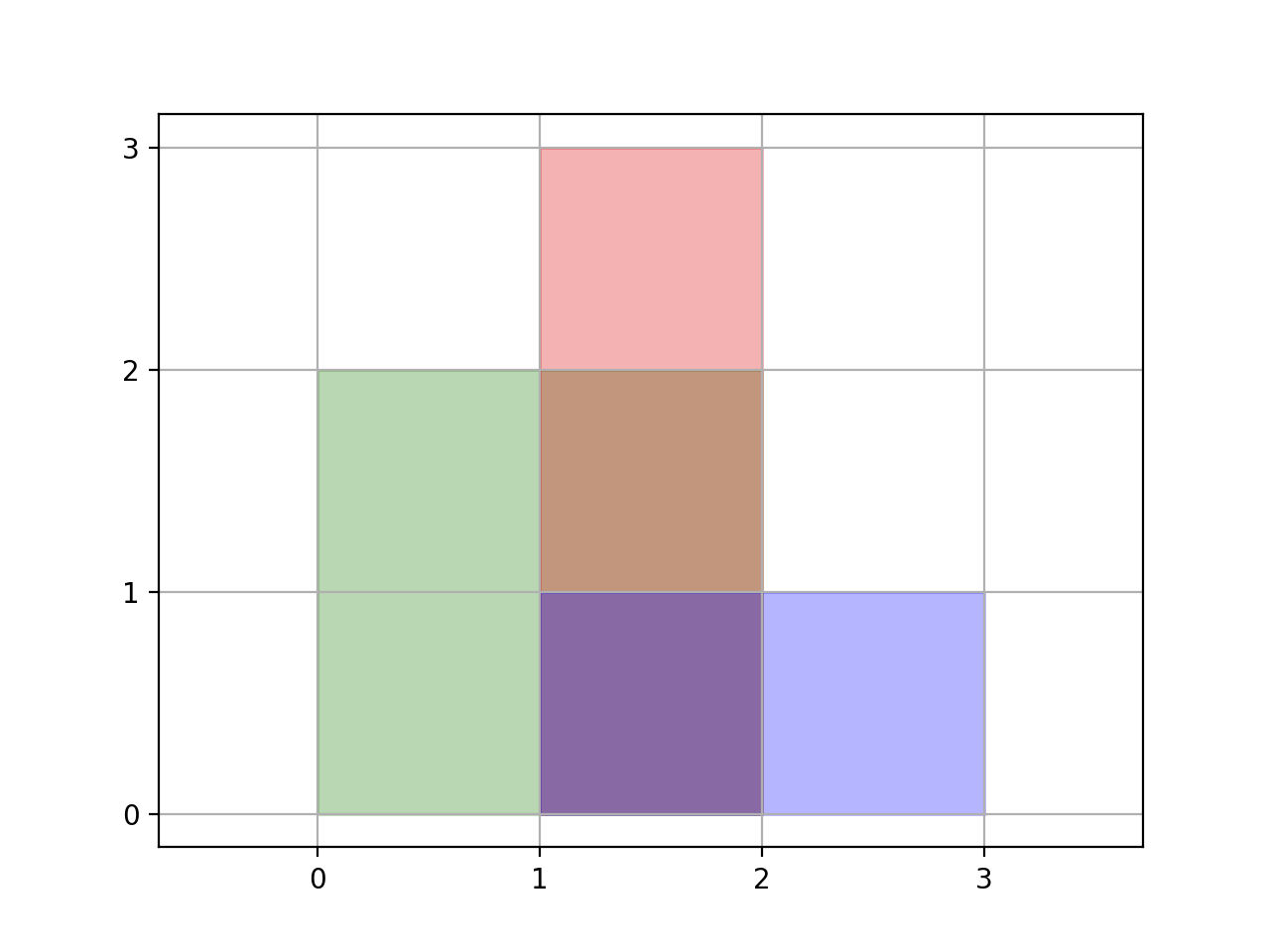
输入:rectangles = [[0,0,2,2],[1,0,2,3],[1,0,3,1]]
输出:6
解释:如图所示,三个矩形覆盖了总面积为 6 的区域。
从(1,1)到(2,2),绿色矩形和红色矩形重叠。
从(1,0)到(2,3),三个矩形都重叠。
解题思路
方法一:离散化 + 扫描线
每个矩形都有一个左边界和一个右边界:
-
当扫描到矩形的左边界时,直线上被矩形覆盖的长度可能会增加;
-
当扫描到矩形的右边界时,直线上被矩形覆盖的长度可能会减少。
假设矩形 \(rectangles\) 的个数为 \(n\) ,那么,矩形的左右边界个数为 \(2n\),因此,扫描线在水平移动过程中,被覆盖的线段长度最多变化 \(2n\) 次,此时,我们就可以将两次变化之间的部分合并起来,一起计算:即这一部分矩形的面积,等于所有被覆盖的线段长度,乘以扫描线在水平方向移动过的距离。
这里会有一个问题,我们如何维护「覆盖的线段长度」呢?
这里同样可以使用到离散化的技巧,扫描线就是一种离散化的技巧,将大范围的连续的坐标转化成 \(2n\) 个离散的坐标。
由于矩形的上下边界也是 \(2n\) 个,它们会将 \(y\) 轴分成 \(2n+1\) 个部分,中间的 \(2n−1\) 个部分均为线段,会被矩形覆盖到,最外侧的 \(2\) 个部分为射线,不会被矩形覆盖到,并且每一个线段要么完全被覆盖,要么完全不被覆盖。
因此我们可以使用一个长度为 \(2n−1\) 的数组 \(coverTimes[i]\),来表示扫描线上第 \(i\) 个线段被矩形覆盖的次数,即:
-
当扫描线遇到一个左边界时,我们就将左边界覆盖到的所有线段对应的覆盖次数 \(coverTimes[i]\) 全部加 \(1\);
-
当扫描线遇到一个右边界时,我们就将右边界覆盖到的所有线段对应的覆盖次数 \(coverTimes[i]\) 全部减 \(1\)。
在处理掉一批横坐标相同的左右边界后,\(coverTimes[i]\) 如果大于 \(0\),说明它被覆盖,我们累加所有被覆盖的线段长度,即可得到「覆盖的线段长度」。
这里,我们使用列表 \(verticalBound\) 保存所有矩形的上下边界,并对其去重,按照从小到大的顺序排序。注意,由于我们对矩形的上下边界排序了,所以,我们需要引入一个变量 \(coverFlag\) 来记录矩形上下边界覆盖的范围。
同时,使用列表 \(sweep\) 记录所有矩形的矩形的左右边界信息:\((x, i, coverFlag)\),其中,\(x\) 为该矩形边界的横坐标,\(i\) 为该矩形的索引,\(coverFlag\) 为覆盖标记。
对于 \(coverFlag\):
-
因为扫描线遇到一个矩形的左边界时,扫描线经过的区域会被该矩形覆盖,因此,记录 \(coverFlag = 1\);
-
因为扫描线遇到一个矩形的右边界时,扫描线经过的区域不会被该矩形覆盖,因此,记录 \(coverFlag = -1\);
然后,我们对所有 \(sweep\) 记录的左右边界信息,按照横坐标从小到大的顺序排序。
因此,算法的步骤如下:
-
首先,我们按照横坐标从小到大的顺序,遍历所有矩形的左右边界 \(sweep[i]\) ,并跳过所有横坐标相同的左右边界,并记录最后一个相同的左右边界的序号 \(j\)。
-
对于这 \(j - i\) 个具有相同横坐标的左右边界 \(sweep[k]\):
-
对于任意一个左右边界 \(sweep[k]\),可以得到:其索引为 \(i =sweep[k][1]\),覆盖标记为 \(flag=sweep[k][2]\);
因此,其纵坐标为:\((y1, y2) = (rectangles[i][1], rectangles[i][3])\)。
-
然后,我们需要遍历扫描线上被所有上下边界覆盖的线段;
对于每一条线段 \(L\):\([verticalBound[p], verticalBound[p + 1]](0 \le p \le 2n - 1)\),如果它落在 \([y1, y2]\) 范围内,就更新它的覆盖次数 \(coverTimes[p]\)。
-
-
然后,我们需要遍历扫描线上所有被矩形覆盖的线段,并累加覆盖区域的线段长度;
我们可以通过 \(coverTimes[p] \gt 0\), 判断当前线段是否被矩形覆盖。
-
最后,我们就可以通过通过被覆盖的线段长度和水平扫描过的距离,求出当前的积分区域的面积,并累加该面积的区域
起始扫描的位置为:\(x_0 = sweep[i][0]\);
水平扫描到的最远距离就是 \(sweep[j + 1]\) 对应的位置,即 \(x_1 = sweep[j + 1][0]\);
因此,当前积分区域的面积:\(S_i = coveredLength \times (x_1 - x_0) = coveredLength \times (sweep[j + 1][0] - sweep[i][0])\)。
方法二:线段树
方法一中对于数组 \(coverTimes\) 的所有操作,都可以使用线段树进行维护。线段树中需要存储:
-
该节点对应的区间被完整覆盖的次数;
-
该节点对应的区间被覆盖的线段长度。
线段树需要支持:
-
区间增加 1;
-
区间减少 1,并且保证每个被增加 1 的区间在之后一定会减少 1;
-
对于所有非 0 的位置,根据它们的权值进行求和。
由于这种方法严重超纲,因此不在这里详细阐述。
代码实现
【方法一】
from typing import List

class Solution:
    def rectangleArea(self, rectangles: List[List[int]]) -> int:
        # Y轴要扫描的范围
        vertical_bound = set()
        for rectangle in rectangles:
            # 下边界
            vertical_bound.add(rectangle[1])
            # 上边界
            vertical_bound.add(rectangle[3])
        vertical_bound = sorted(vertical_bound)

        m = len(vertical_bound)
        # 记录所有的左右边界
        sweep = list()
        for i, rectangle in enumerate(rectangles):
            # 左边界,遇到覆盖次数加1
            sweep.append((rectangle[0], i, 1))
            # 右边界,遇到覆盖次数减1
            sweep.append((rectangle[2], i, -1))

        # 将矩形的所有左右边界按从小到大的顺序排序
        sweep.sort()

        # cover_times[i] 表示第 i 个线段被矩形覆盖的次数
        cover_times = [0] * (m - 1)
        result = 0
        i = 0
        # 遍历所有的X轴的边界
        while i < len(sweep):
            j = i
            # 横坐标相同的左右边界
            while j + 1 < len(sweep) and sweep[i][0] == sweep[j + 1][0]:
                j += 1
            if j + 1 == len(sweep):
                break

            # 一次性地处理掉[i, j]范围内,一批横坐标相同的左右边界
            for k in range(i, j + 1):
                _, index, diff = sweep[k]
                # 找到这些边界对应的纵坐标
                y1, y2 = rectangles[index][1], rectangles[index][3]
                # 遍历扫描线上所有被上下边界覆盖的线段
                for p in range(m - 1):
                    # 如果纵坐标在具有相同X边界的范围内,就更新它的覆盖次数
                    if y1 <= vertical_bound[p] and vertical_bound[p + 1] <= y2:
                        cover_times[p] += diff

            # 扫描线上被矩形覆盖的线段之和
            covered_length = 0
            # 遍历扫描线上所有被矩形覆盖的线段
            for p in range(m - 1):
                if cover_times[p] > 0:
                    # 纵坐标上每一段覆盖的范围一定是两个相邻线段的差值
                    covered_length += (vertical_bound[p + 1] - vertical_bound[p])
            # 计算扫描线经过范围内被覆盖的面积
            result += covered_length * (sweep[j + 1][0] - sweep[i][0])
            i = j + 1

        return result % (10 ** 9 + 7)
【方法二】
import bisect
from typing import List


class Segtree:
    def __init__(self):
        self.cover = 0
        self.length = 0
        self.max_length = 0

    @classmethod
    def init(cls, tree: List["Segtree"], idx: int, l: int, r: int, hbound: List[int]) -> None:
        tree[idx].cover = tree[idx].length = 0
        if l == r:
            tree[idx].max_length = hbound[l] - hbound[l - 1]
            return

        mid = (l + r) // 2
        cls.init(tree, idx * 2, l, mid, hbound)
        cls.init(tree, idx * 2 + 1, mid + 1, r, hbound)
        tree[idx].max_length = tree[idx * 2].max_length + tree[idx * 2 + 1].max_length

    @classmethod
    def update(cls, tree: List["Segtree"], index: int, l: int, r: int, ul: int, ur: int, diff: int) -> None:
        if l > ur or r < ul:
            return
        if ul <= l and r <= ur:
            tree[index].cover += diff
            cls.pushup(tree, index, l, r)
            return

        mid = (l + r) // 2
        cls.update(tree, index * 2, l, mid, ul, ur, diff)
        cls.update(tree, index * 2 + 1, mid + 1, r, ul, ur, diff)
        cls.pushup(tree, index, l, r)

    @classmethod
    def pushup(cls, tree: List["Segtree"], idx: int, l: int, r: int) -> None:
        if tree[idx].cover > 0:
            tree[idx].length = tree[idx].max_length
        elif l == r:
            tree[idx].length = 0
        else:
            tree[idx].length = tree[idx * 2].length + tree[idx * 2 + 1].length


class Solution:
    def rectangleArea(self, rectangles: List[List[int]]) -> int:
        hbound = set()
        for rectangle in rectangles:
            # 下边界
            hbound.add(rectangle[1])
            # 上边界
            hbound.add(rectangle[3])

        hbound = sorted(hbound)
        m = len(hbound)
        # 线段树有 m-1 个叶子节点,对应着 m-1 个会被完整覆盖的线段,需要开辟 ~4m 大小的空间
        tree = [Segtree() for _ in range(m * 4 + 1)]

        Segtree.init(tree, 1, 1, m - 1, hbound)
        sweep = list()
        for i, rectangle in enumerate(rectangles):
            # 左边界
            sweep.append((rectangle[0], i, 1))
            # 右边界
            sweep.append((rectangle[2], i, -1))
        sweep.sort()

        result = 0
        i = 0
        while i < len(sweep):
            j = i
            while j + 1 < len(sweep) and sweep[i][0] == sweep[j + 1][0]:
                j += 1
            if j + 1 == len(sweep):
                break

            # 一次性地处理掉一批横坐标相同的左右边界
            for k in range(i, j + 1):
                _, index, diff = sweep[k]
                # 使用二分查找得到完整覆盖的线段的编号范围
                left = bisect.bisect_left(hbound, rectangles[index][1]) + 1
                right = bisect.bisect_left(hbound, rectangles[index][3])
                Segtree.update(tree, 1, 1, m - 1, left, right, diff)

            result += tree[1].length * (sweep[j + 1][0] - sweep[j][0])
            i = j + 1

        return result % (10 ** 9 + 7)
参考:
-
扫描线Sweep Line算法总结
-
Time Intersection
-
线段树
-
矩形面积 II
-
扫描线