class StepByStep():
    def __init__(self, model, loss_fn, optimizer):
        self.device = 'cuda' if torch.cuda.is_available() else 'cpu'
        self.model = model.to(self.device)
        self.loss_fn = loss_fn
        self.optimizer = optimizer

    def to(self, device):
        # This method allows the user to specify a different device
        # It sets the corresponding attribute (to be used later in
        # the mini-batches) and sends the model to the device
        try:
            self.device = device
            self.model.to(self.device)
        except RuntimeError:
            self.device = 'cuda' if torch.cuda.is_available() else 'cpu'
            print(f"Couldn't send it to {device}, sending it to {self.device} instead.")
            self.model.to(self.device)
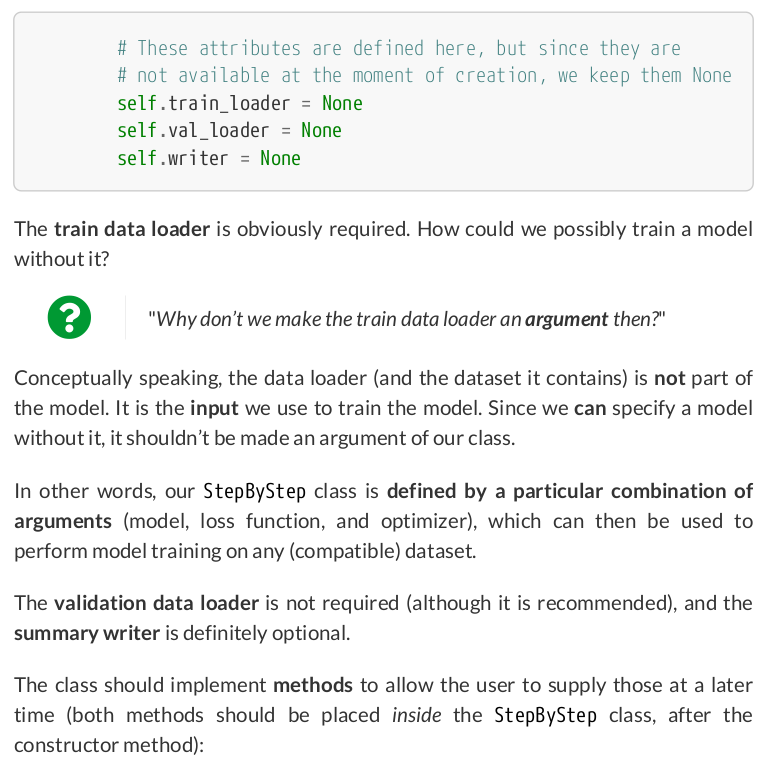
class StepByStep():
    def __init__(self, model, loss_fn, optimizer):
        self.device = 'cuda' if torch.cuda.is_available() else 'cpu'
        self.model = model.to(self.device)
        self.loss_fn = loss_fn
        self.optimizer = optimizer

        # These attributes are defined here, but since they are
        # not available at the moment of creation, we keep them None
        self.train_loader = None
        self.val_loader = None
        self.writer = None

    def to(self, device):
        # This method allows the user to specify a different device
        # It sets the corresponding attribute (to be used later in
        # the mini-batches) and sends the model to the device
        try:
            self.device = device
            self.model.to(self.device)
        except RuntimeError:
            self.device = 'cuda' if torch.cuda.is_available() else 'cpu'
            print(f"Couldn't send it to {device}, sending it to {self.device} instead.")
            self.model.to(self.device)

    def set_loaders(self, train_loader, val_loader=None):
        self.train_loader = train_loader
        self.val_loader = val_loader

    def set_tensorboard(self, name, folder='runs'):
        # This method allows the user to create a SummaryWriter to interface with TensorBoard
        suffix = datetime.now().strftime('%Y%m%d%H%M%S')
        self.writer = SummaryWriter(f'{folder}/{name}_{suffix}')

class StepByStep():
    def __init__(self, model, loss_fn, optimizer):
        self.device = 'cuda' if torch.cuda.is_available() else 'cpu'
        self.model = model.to(self.device)
        self.loss_fn = loss_fn
        self.optimizer = optimizer

        # These attributes are defined here, but since they are
        # not available at the moment of creation, we keep them None
        self.train_loader = None
        self.val_loader = None
        self.writer = None

        # These attributes are going to be computed internally
        self.losses = []
        self.val_losses = []
        self.total_epochs = 0

    def to(self, device):
        # This method allows the user to specify a different device
        # It sets the corresponding attribute (to be used later in
        # the mini-batches) and sends the model to the device
        try:
            self.device = device
            self.model.to(self.device)
        except RuntimeError:
            self.device = 'cuda' if torch.cuda.is_available() else 'cpu'
            print(f"Couldn't send it to {device}, sending it to {self.device} instead.")
            self.model.to(self.device)

    def set_loaders(self, train_loader, val_loader=None):
        self.train_loader = train_loader
        self.val_loader = val_loader

    def set_tensorboard(self, name, folder='runs'):
        # This method allows the user to create a SummaryWriter to interface with TensorBoard
        suffix = datetime.now().strftime('%Y%m%d%H%M%S')
        self.writer = SummaryWriter(f'{folder}/{name}_{suffix}')
class StepByStep():
    def __init__(self, model, loss_fn, optimizer):
        self.device = 'cuda' if torch.cuda.is_available() else 'cpu'
        self.model = model.to(self.device)
        self.loss_fn = loss_fn
        self.optimizer = optimizer

        # These attributes are defined here, but since they are
        # not available at the moment of creation, we keep them None
        self.train_loader = None
        self.val_loader = None
        self.writer = None

        # These attributes are going to be computed internally
        self.losses = []
        self.val_losses = []
        self.total_epochs = 0

        # Create the train_step function for model, loss function and optimizer
        # Note: there are NO ARGS there! It makes use of the class attributes directly
        self.train_step_fn = self._make_train_step_fn()
        # Create the val_step function for model and loss function
        self.val_step_fn = self._make_val_step_fn()

    def to(self, device):
        # This method allows the user to specify a different device
        # It sets the corresponding attribute (to be used later in
        # the mini-batches) and sends the model to the device
        try:
            self.device = device
            self.model.to(self.device)
        except RuntimeError:
            self.device = 'cuda' if torch.cuda.is_available() else 'cpu'
            print(f"Couldn't send it to {device}, sending it to {self.device} instead.")
            self.model.to(self.device)

    def set_loaders(self, train_loader, val_loader=None):
        self.train_loader = train_loader
        self.val_loader = val_loader

    def set_tensorboard(self, name, folder='runs'):
        # This method allows the user to create a SummaryWriter to interface with TensorBoard
        suffix = datetime.now().strftime('%Y%m%d%H%M%S')
        self.writer = SummaryWriter(f'{folder}/{name}_{suffix}')

    def _make_train_step_fn(self):
        # Build function that performs a step in the train loop
        def perform_train_step_fn(x, y):
            self.model.train()

            yhat = self.model(x)
            loss = self.loss_fn(yhat, y)
            loss.backward()
            self.optimizer.step()
            self.optimizer.zero_grad()

            return loss.item()

        return perform_train_step_fn

    def _make_val_step_fn(self):
        # Build function that performs a step in the validation loop
        def perform_val_step_fn(x, y):
            self.model.eval()

            yhat = self.model(x)
            loss = self.loss_fn(yhat, y)

            return loss.item()

        return perform_val_step_fn




class StepByStep():
    def __init__(self, model, loss_fn, optimizer):
        self.device = 'cuda' if torch.cuda.is_available() else 'cpu'
        self.model = model.to(self.device)
        self.loss_fn = loss_fn
        self.optimizer = optimizer

        # These attributes are defined here, but since they are
        # not available at the moment of creation, we keep them None
        self.train_loader = None
        self.val_loader = None
        self.writer = None

        # These attributes are going to be computed internally
        self.losses = []
        self.val_losses = []
        self.total_epochs = 0

        # Create the train_step function for model, loss function and optimizer
        # Note: there are NO ARGS there! It makes use of the class attributes directly
        self.train_step_fn = self._make_train_step_fn()
        # Create the val_step function for model and loss function
        self.val_step_fn = self._make_val_step_fn()

    def to(self, device):
        # This method allows the user to specify a different device
        # It sets the corresponding attribute (to be used later in
        # the mini-batches) and sends the model to the device
        try:
            self.device = device
            self.model.to(self.device)
        except RuntimeError:
            self.device = 'cuda' if torch.cuda.is_available() else 'cpu'
            print(f"Couldn't send it to {device}, sending it to {self.device} instead.")
            self.model.to(self.device)

    def set_seed(self, seed=42):
        torch.backends.cudnn.deterministic = True
        torch.backends.cudnn.benchmark = False
        torch.manual_seed(seed)

    def set_loaders(self, train_loader, val_loader=None):
        self.train_loader = train_loader
        self.val_loader = val_loader

    def set_tensorboard(self, name, folder='runs'):
        # This method allows the user to create a SummaryWriter to interface with TensorBoard
        suffix = datetime.now().strftime('%Y%m%d%H%M%S')
        self.writer = SummaryWriter(f'{folder}/{name}_{suffix}')

    def train(self, n_epochs, seed=42):
        self.set_seed(seed)

        for epoch in range(n_epochs):
            # Keep track of the numbers of epochs by updating the corresponding attribute
            self.total_epochs += 1

            loss = self._mini_batch(validation=False)
            self.losses.append(loss)

            with torch.no_grad():
                val_loss = self._mini_batch(validation=True)
                self.val_losses.append(val_loss)

            # If a SummaryWriter has been set...
            if self.writer:
                scalars = {'training': loss}
                if val_loss is not None:
                    scalars.update({'validation': val_loss})
                self.writer.add_scalars(main_tag='loss',
                                        tag_scalar_dict=scalars,
                                        global_step=epoch)

        if self.writer:
            # Flush the writer
            self.writer.flush()

    def save_checkpoint(self, filename):
        checkpoint = {'epoch': self.total_epochs,
                      'model_state_dict': self.model.state_dict(),
                      'optimizer_state_dict': self.optimizer.state_dict(),
                      'losses': self.losses,
                      'val_losses': self.val_losses}
        torch.save(checkpoint, filename)

    def load_checkpoint(self, filename):
        checkpoint = torch.load(filename)

        self.model.load_state_dict(checkpoint['model_state_dict'])
        self.optimizer.load_state_dict(checkpoint['optimizer_state_dict'])

        self.total_epochs = checkpoint['epoch']
        self.losses = checkpoint['losses']
        self.val_losses = checkpoint['val_losses']

        self.model.train()  # always use TRAIN for resuming training

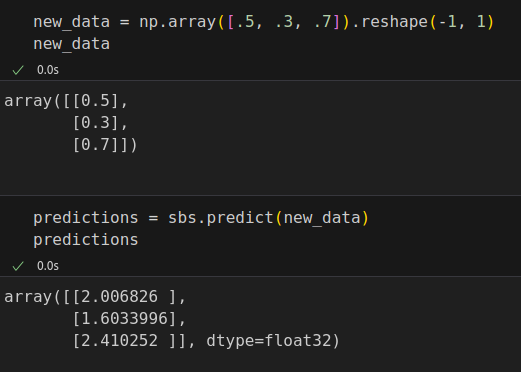
    def predict(self, x):
        # Set it to evaluation mode for predictions
        self.model.eval()

        x_tensor = torch.as_tensor(x).float().to(self.device)
        y_hat_tensor = self.model(x_tensor)

        # Set it back to train mode
        self.model.train()

        return y_hat_tensor.detach().cpu().numpy()

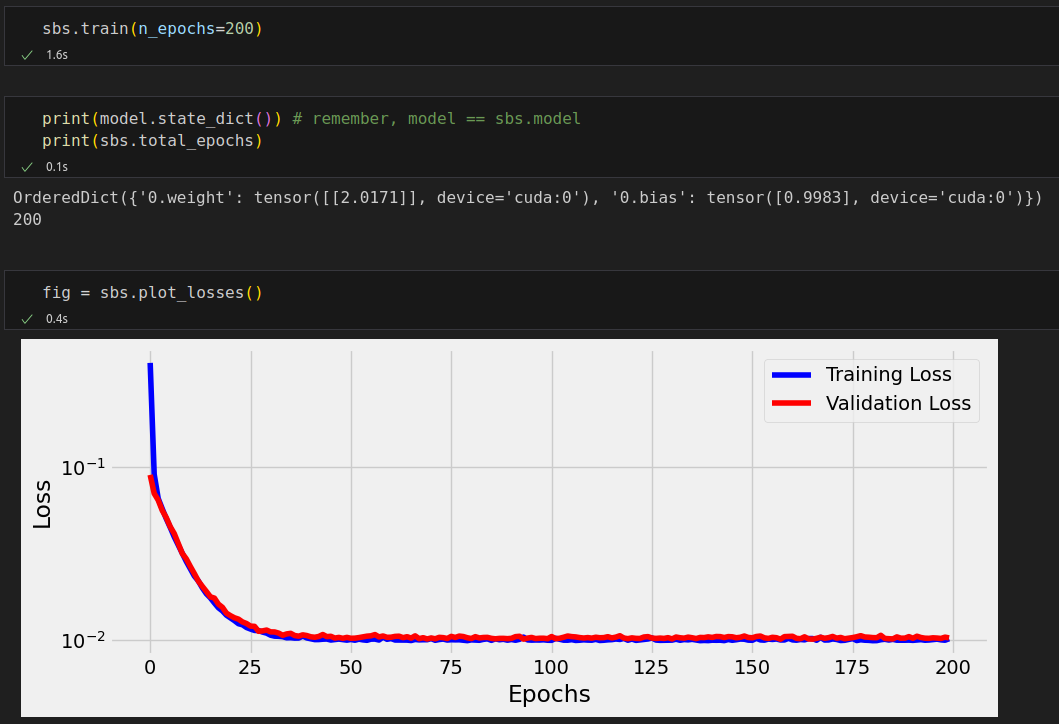
    def plot_losses(self):
        fig = plt.figure(figsize=(10, 4))
        plt.xlabel('Epochs')
        plt.ylabel('Loss')
        plt.yscale('log')
        plt.plot(self.losses, label='Training Loss', c='b')
        if self.val_losses:
            plt.plot(self.val_losses, label='Validation Loss', c='r')
        plt.legend()
        fig.tight_layout()
        return fig

    def add_graph(self):
        if self.train_loader and self.writer:
            # Fetche a single mini-batch so we can use add_graph
            x_sample, y_sample = next(iter(self.train_loader))
            self.writer.add_graph(self.model, x_sample.to(self.device))

    def _make_train_step_fn(self):
        # Build function that performs a step in the train loop
        def perform_train_step_fn(x, y):
            self.model.train()

            yhat = self.model(x)
            loss = self.loss_fn(yhat, y)
            loss.backward()
            self.optimizer.step()
            self.optimizer.zero_grad()

            return loss.item()

        return perform_train_step_fn

    def _make_val_step_fn(self):
        # Build function that performs a step in the validation loop
        def perform_val_step_fn(x, y):
            self.model.eval()

            yhat = self.model(x)
            loss = self.loss_fn(yhat, y)

            return loss.item()

        return perform_val_step_fn

    def _mini_batch(self, validation=False):
        # The mini-batch can be used with both loaders
        # The argument `validation` defines which loader and
        # corresponding step function is going to be used
        if validation:
            data_loader = self.val_loader
            step_fn = self.val_step_fn
        else:
            data_loader = self.train_loader
            step_fn = self.train_step_fn

        mini_batch_losses = []
        for x_batch, y_batch in data_loader:
            x_batch = x_batch.to(self.device)
            y_batch = y_batch.to(self.device)

            mini_batch_loss = step_fn(x_batch, y_batch)
            mini_batch_losses.append(mini_batch_loss)

        loss = np.mean(mini_batch_losses)
        return loss

%%writefile model_configuration/v4.py

lr = .1

torch.manual_seed(42)

model = nn.Sequential(nn.Linear(1, 1))
optimizer = torch.optim.SGD(model.parameters(), lr=lr)
loss_fn = nn.MSELoss(reduction='mean')



sbs = StepByStep(model, loss_fn, optimizer)
sbs.set_loaders(train_loader, val_loader)
sbs.set_tensorboard('classy')




sbs.save_checkpoint('model_checkpoint.pth')


new_sbs = StepByStep(model, loss_fn, optimizer)


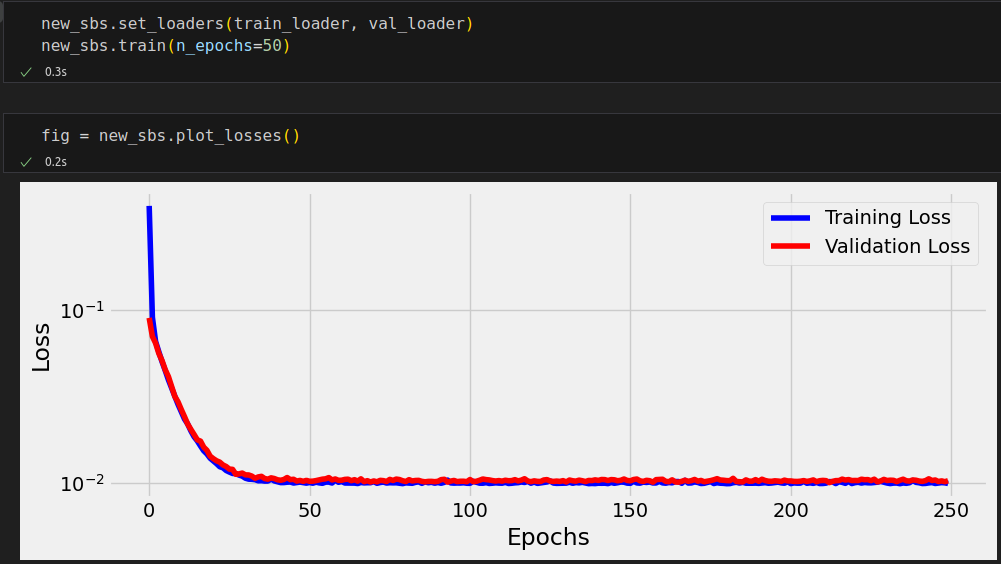



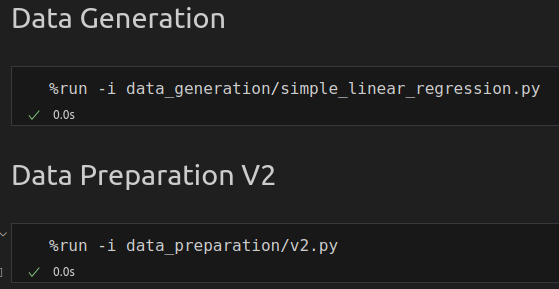
# %load data_preparation/v2.py

torch.manual_seed(13)

# Build tensors from numpy arrays BEFORE split
x_tensor = torch.from_numpy(x).float().reshape(-1, 1)
y_tensor = torch.from_numpy(y).float().reshape(-1, 1)

# Build dataset containing ALL data points
dataset = TensorDataset(x_tensor, y_tensor)

# Perform split
ratio = .8
n_total = len(dataset)
n_train = int(n_total * ratio)
n_val = n_total - n_train

train_data, val_data = random_split(dataset, [n_train, n_val])

# Build a loader for each set
train_loader = DataLoader(dataset=train_data, batch_size=16, shuffle=True)
val_loader = DataLoader(dataset=val_data, batch_size=16)
# %load model_configuration/v4.py

lr = .1

torch.manual_seed(42)

model = nn.Sequential(nn.Linear(1, 1))
optimizer = torch.optim.SGD(model.parameters(), lr=lr)
loss_fn = nn.MSELoss(reduction='mean')
n_epochs = 200

sbs = StepByStep(model, loss_fn, optimizer)
sbs.set_loaders(train_loader, val_loader)
sbs.set_tensorboard('classy')
sbs.train(n_epochs=n_epochs)