22天入门设计模式(C++版)
第一、什么是设计模式?
设计模式是软件设计中常见问题的典型解决方案。 它们就像能根据需求进行调整的预制蓝图, 可用于解决代码中反复出现的设计问题。
设计模式与方法或库的使用方式不同, 你很难直接在自己的程序中套用某个设计模式。 模式并不是一段特定的代码, 而是解决特定问题的一般性概念。 你可以根据模式来实现符合自己程序实际所需的解决方案。
人们常常会混淆模式和算法, 因为两者在概念上都是已知特定问题的典型解决方案。 但算法总是明确定义达成特定目标所需的一系列步骤, 而模式则是对解决方案的更高层次描述。 同一模式在两个不同程序中的实现代码可能会不一样。
算法更像是菜谱: 提供达成目标的明确步骤。 而模式更像是蓝图: 你可以看到最终的结果和模式的功能, 但需要自己确定实现步骤。
第二、模式包含哪些内容?
大部分模式都有正规的描述方式, 以便在不同情况下使用。 模式的描述通常会包括以下部分:
- 意图部分简单描述问题和解决方案。
- 动机部分将进一步解释问题并说明模式会如何提供解决方案。
- 结构部分展示模式的每个部分和它们之间的关系。
- 在不同语言中的实现提供流行编程语言的代码, 让读者更好地理解模式背后的思想。
部分模式介绍中还列出其他的一些实用细节, 例如模式的适用性、 实现步骤以及与其他模式的关系。
第三、设计模式分类?
-
创建型模式提供创建对象的机制, 增加已有代码的灵活性和可复用性。
-
结构型模式介绍如何将对象和类组装成较大的结构, 并同时保持结构的灵活和高效。
-
行为模式负责对象间的高效沟通和职责委派。
第一、工厂方法模式
(虚拟构造函数、Virtual Constructor、Factory Method)
1.意图
工厂方法模式是一种创建型设计模式, 其在父类中提供一个创建对象的方法, 允许子类决定实例化对象的类型。
2.工厂方法模式结构
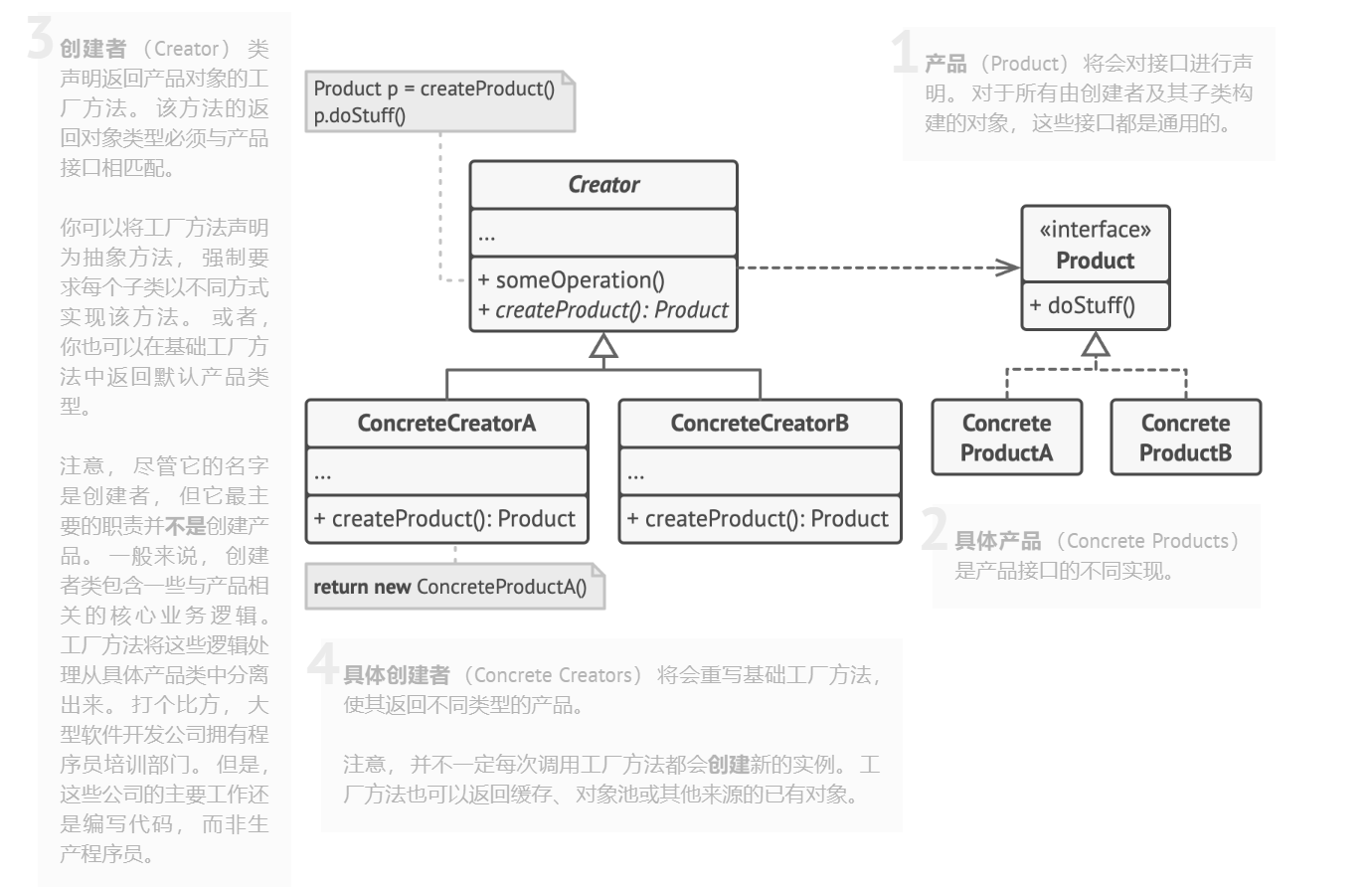
3.工厂方法模式适合应用场景
3.1 当你在编写代码的过程中, 如果无法预知对象确切类别及其依赖关系时, 可使用工厂方法。
3.2 如果你希望用户能扩展你软件库或框架的内部组件, 可使用工厂方法。
3.3 如果你希望复用现有对象来节省系统资源, 而不是每次都重新创建对象, 可使用工厂方法。
4.工厂方法模式实现方式
-
让所有产品都遵循同一接口。 该接口必须声明对所有产品都有意义的方法。
-
在创建类中添加一个空的工厂方法。 该方法的返回类型必须遵循通用的产品接口。
-
在创建者代码中找到对于产品构造函数的所有引用。 将它们依次替换为对于工厂方法的调用, 同时将创建产品的代码移入工厂方法。
你可能需要在工厂方法中添加临时参数来控制返回的产品类型。
工厂方法的代码看上去可能非常糟糕。 其中可能会有复杂的
switch分支运算符, 用于选择各种需要实例化的产品类。 但是不要担心, 我们很快就会修复这个问题。 -
现在, 为工厂方法中的每种产品编写一个创建者子类, 然后在子类中重写工厂方法, 并将基本方法中的相关创建代码移动到工厂方法中。
-
如果应用中的产品类型太多, 那么为每个产品创建子类并无太大必要, 这时你也可以在子类中复用基类中的控制参数。
例如, 设想你有以下一些层次结构的类。 基类
邮件及其子类航空邮件和陆路邮件; 运输及其子类飞机,卡车和火车。 航空邮件仅使用飞机对象, 而陆路邮件则会同时使用卡车和火车对象。 你可以编写一个新的子类 (例如火车邮件) 来处理这两种情况, 但是还有其他可选的方案。 客户端代码可以给陆路邮件类传递一个参数, 用于控制其希望获得的产品。 -
如果代码经过上述移动后, 基础工厂方法中已经没有任何代码, 你可以将其转变为抽象类。 如果基础工厂方法中还有其他语句, 你可以将其设置为该方法的默认行为。
5.C++示例代码
#include <iostream>
#include <string>

/**
 * The Product interface declares the operations that all concrete products must
 * implement.
 */

class Product {
public:
	virtual ~Product() {}
	virtual std::string Operation() const = 0;
};

/**
 * Concrete Products provide various implementations of the Product interface.
 */
class ConcreteProduct1 : public Product {
public:
	std::string Operation() const override {
		return "{Result of the ConcreteProduct1}";
	}
};
class ConcreteProduct2 : public Product {
public:
	std::string Operation() const override {
		return "{Result of the ConcreteProduct2}";
	}
};

/**
 * The Creator class declares the factory method that is supposed to return an
 * object of a Product class. The Creator's subclasses usually provide the
 * implementation of this method.
 */

class Creator {
	/**
	 * Note that the Creator may also provide some default implementation of the
	 * factory method.
	 */
public:
	virtual ~Creator() {};
	virtual Product* FactoryMethod() const = 0;
	/**
	 * Also note that, despite its name, the Creator's primary responsibility is
	 * not creating products. Usually, it contains some core business logic that
	 * relies on Product objects, returned by the factory method. Subclasses can
	 * indirectly change that business logic by overriding the factory method and
	 * returning a different type of product from it.
	 */

	std::string SomeOperation() const {
		// Call the factory method to create a Product object.
		Product* product = this->FactoryMethod();
		// Now, use the product.
		std::string result = "Creator: The same creator's code has just worked with " + product->Operation();
		delete product;
		return result;
	}
};

/**
 * Concrete Creators override the factory method in order to change the
 * resulting product's type.
 */
class ConcreteCreator1 : public Creator {
	/**
	 * Note that the signature of the method still uses the abstract product type,
	 * even though the concrete product is actually returned from the method. This
	 * way the Creator can stay independent of concrete product classes.
	 */
public:
	Product* FactoryMethod() const override {
		return new ConcreteProduct1();
	}
};

class ConcreteCreator2 : public Creator {
public:
	Product* FactoryMethod() const override {
		return new ConcreteProduct2();
	}
};

/**
 * The client code works with an instance of a concrete creator, albeit through
 * its base interface. As long as the client keeps working with the creator via
 * the base interface, you can pass it any creator's subclass.
 */
void ClientCode(const Creator& creator) {
	// ...
	std::cout << "Client: I'm not aware of the creator's class, but it still works.\n"
		<< creator.SomeOperation() << std::endl;
	// ...
}

/**
 * The Application picks a creator's type depending on the configuration or
 * environment.
 */

int main() {
	std::cout << "App: Launched with the ConcreteCreator1.\n";
	Creator* creator = new ConcreteCreator1();
	ClientCode(*creator);
	std::cout << std::endl;
	std::cout << "App: Launched with the ConcreteCreator2.\n";
	Creator* creator2 = new ConcreteCreator2();
	ClientCode(*creator2);

	delete creator;
	delete creator2;
	return 0;
}